
Eighteen Months In, I Finally Arrived
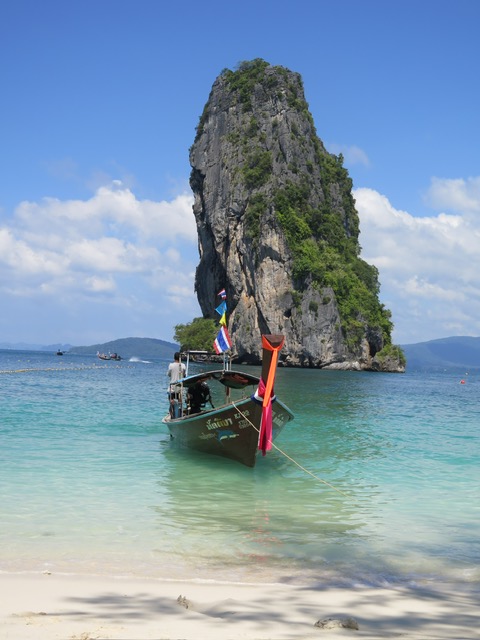
For eighteen months I lived in the country I had wanted to go to my whole career. Thailand was the assignment I’d still dreamed about since I was thirteen, when my father was stationed there and I fell in love with a place I barely understood yet. I spent decades hoping I would have the chance to go back. And when it finally did, I spent a year and a half barely looking up.
Not because I didn’t care. Because there was always more work. I was traveling constantly — across Thailand, across Asia — chasing opportunities, building relationships, standing up operations. The work was real and it mattered, and it also meant I was moving through the most meaningful country of my life the way you move through an airport. Present, but not arriving. I was in Thailand. I hadn’t started seeing it.
Then my marriage ended, and the work travel stopped — an administrative stand-down that left me, for the first time in many years, with no itinerary and no plan. My head was in an unfamiliar place. I was at loose ends in the one country I’d spent decades wanting to know, and I hadn’t done much of anything with it.
I don’t fully know what made me decide what I decided next. But somewhere in that disorientation, a thought hardened into a rule: I was going to go somewhere new every month, at minimum. The mission at work still mattered — I wasn’t going to half-ass it — but I was done letting the dream assignment pass by unlived. It just felt important, in a way I couldn’t yet explain.
I wasn’t looking for a relationship. I’d just come out of one, and what I wanted was to be alone with my own thoughts for a while. My buddy and I were out at a happy hour when we struck up a conversation with a Thai woman, and before long she invited us to come meet her friend at the sports pub where she worked. What she had in mind, it turned out, was introducing that friend to my buddy — she hadn’t yet clocked that he was married and very much not in the market. I, on the other hand, was unattached and paying close attention. The friend’s name was On: sharp-eyed and warm, the kind of beautiful that stops a conversation. The matchmaking never had a chance. I kept coming back to her restaurant anyway, usually late, when the place had quieted down enough for us to actually talk.
Because I wasn’t looking for anything, I think I was less guarded than I’d been in years. We talked for months before anything more than friendship took shape, and somewhere in those conversations I told her what I’d told almost no one — that I didn’t want to see Thailand like a tourist. I wanted to experience it like someone who actually loved it. She loved exploring too. So I asked her the only question that mattered: would she be my guide? Would she show me her country through her own eyes, on the weekends, away from both our jobs?
That’s where it started. And it started at Railay Beach.
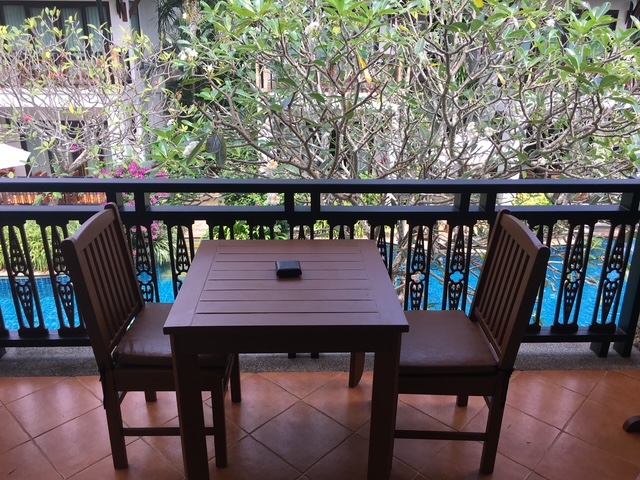
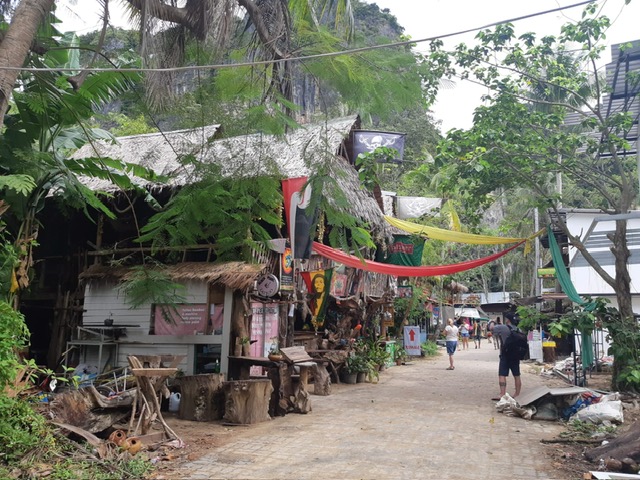
Railay isn’t reachable by road — you get there by longtail boat from Krabi, which is part of what makes it feel separate from everything else, a place you have to choose to go to. We stayed in a bungalow at Railay Village, with a private pool just outside the door, plumeria trees perfuming the air, a walking street at night lined with restaurants and dive shops and pubs spilling live music into the dark. It was, simply, perfect — and it became ours. To this day, whenever we’re in Thailand, Railay is the place we return to, because it was the first place we went together.
We packed that long weekend full. We hired a longtail captain and told him to skip the postcard stops — show us what he actually knew, the hidden corners. He delivered. We climbed a slick, rocky, genuinely sketchy slope to a viewpoint that made the climb worth every scraped knuckle, and took more photos than we needed to. We let a guide talk us into rock climbing on the limestone cliffs we’d been admiring from the boat — we’d watched other people scale them and wanted to try it ourselves, so we booked a half-day, hedging our bets in case we wanted to do something else after.
I’d pictured myself as the guy who makes it look easy — clip in, scale the wall, nod modestly at the bottom. I was not that guy. We did not need the rest of the day. Within minutes I was drenched in sweat, fingers cut, knees skinned, very much not scaling the rock face like the mountain goat I’d imagined myself to be. On did better than I did. We traded turns climbing and rappelling until we were both completely spent, tipped our instructor well, and walked away exhausted, sore, and laughing about it — and we still laugh about it now.
What strikes me looking back isn’t really the rock climbing or even the bungalow with the pool. It’s the difference between seeing a place and seeing it with someone who belongs to it. I’d been to Africa, the Pacific Islands, Europe, the Middle East — work took me everywhere, and work gives you a particular kind of memory, efficient and thin. Occasionally I got something closer to real travel, but nothing like what happened on that first trip with On. I wasn’t just seeing Thailand anymore. I was seeing it through her eyes too, and her eyes had grown up here. That changes what you notice. It changes what matters.
After Railay, something shifted in how I moved through the world — not just in Thailand, but in general. I’d been carrying around the idea of what eventually became Live Bodhi for years before I had a name for it, but it started to actually take shape during that stretch of my life. Starting over. Realizing the plan I thought I’d been building toward simply wasn’t happening. Meeting someone who understood and appreciated me in a way I hadn’t experienced before. It was a fast education. I started thinking seriously, for the first time, about life beyond the job — and about how finite all of this actually is. Railay turned into the first of what I now think of as Bodhi Moments, and once I had language for it, I started noticing them everywhere — the ones still ahead of me, and the ones I’d already lived through without naming.
People sometimes ask what I was avoiding during those first eighteen months. Honestly, I don’t think it was avoidance. I was doing what I thought the job required. I had a mission, a family to take care of, expectations to meet, and I met them. What I see now is that I was never much of a planner. I went with the current. I did what seemed expected, and that worked — right up until it didn’t.
On and I spent the next eighteen months building a relationship full of moments like that one, and we’re committed to keep building them for the rest of our lives. Looking back at that strange, unmoored period — divorce paperwork, a stand-down with nowhere to go, a man in his early fifties suddenly unsure what came next — I’m grateful for every bit of it, painful parts included. It unfolded exactly as it needed to. If any piece of it had gone differently, I wouldn’t have been standing in that sports pub on that particular night.
What stays with me most isn’t a single image so much as a quality of attention. On sees things with a kind of unguarded, childlike wonder — genuinely new, every time. Watching her experience a place for the first time taught me to slow down enough to experience it for what is my own first time, too. She is completely present wherever she is. Eighteen months into my dream assignment, I finally learned how to be present in it too.
If this was useful, the next one will be too.
One short essay when it’s ready. No schedule, no spam, no tracking.