
Get Busy Living
New here? Get the next one.
One email, no schedule.
From Stephen King, Rita Hayworth and Shawshank Redemption, in Different Seasons (1982); film The Shawshank Redemption, dir. Frank Darabont (1994)
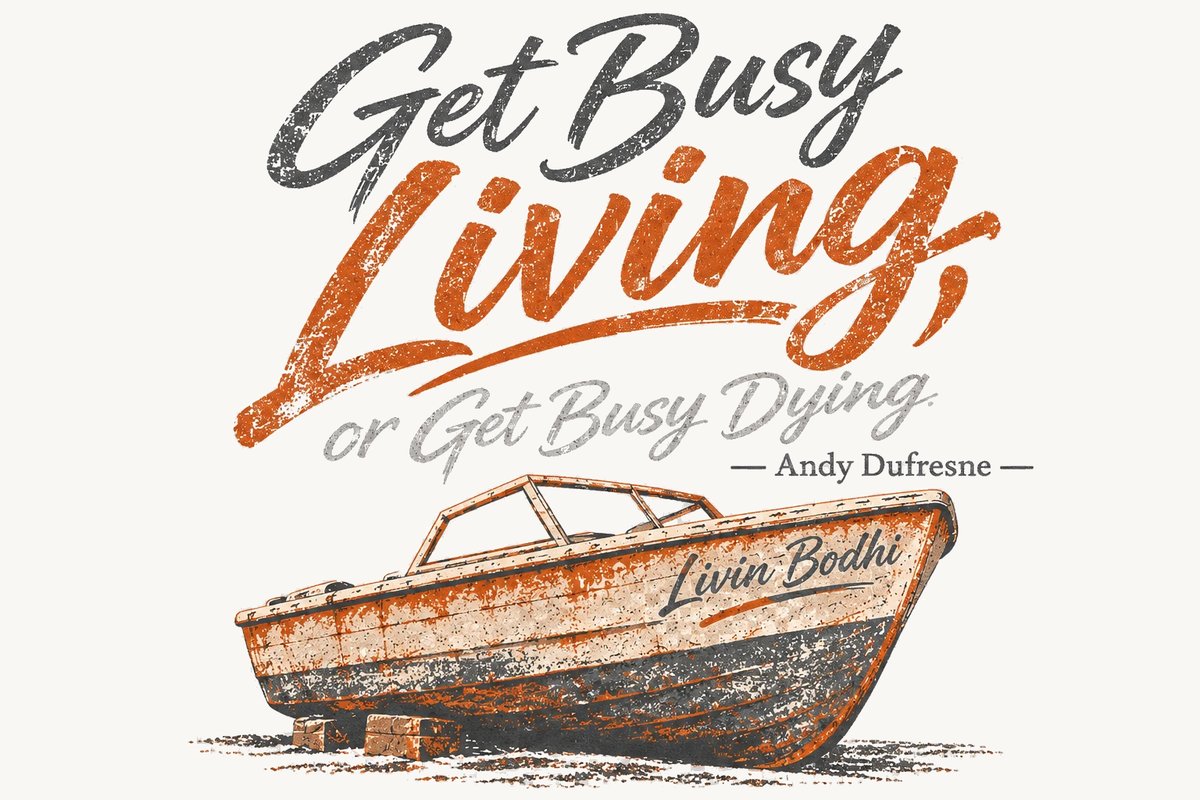
The Shawshank Redemption is one of my favorite movies, and at its heart is one of the best lines ever put on film. Andy Dufresne sits against the yard wall with Red, years into two life sentences for a crime he didn’t commit, and says it:
“I guess it comes down to a simple choice, really. Get busy living or get busy dying.”
That’s the line the whole film turns on. It started in Stephen King’s novella Rita Hayworth and Shawshank Redemption, from his 1982 collection Different Seasons. Frank Darabont’s 1994 film made it the line everybody knows.
The film takes its time and argues the line out over two men’s lives. The first is Brooks.
Brooks Hatlen spends about half a century in Shawshank. He runs the library and keeps a pet crow. Then he’s paroled, and the gate that should mean freedom is instead terrifying. The film gives his release a small story of its own, told in his own voice through a letter to the men he left behind. He gets a room in a halfway house and a job bagging groceries. Red has a word for it: institutionalized. The walls got inside him. Brooks carves “Brooks was here” into a beam, then he takes his own life. The film doesn’t look away from it. The gate opened, but he never got out.
Brooks didn’t fail to escape. He was released. What he never did was start living while he still had the walls around him, so when the walls went away there was nothing underneath to stand on.
Andy is the other answer, and watching him is the joy of the film. For nineteen years he gets busy living, right there inside. He talks a guard into a round of cold beers for the men tarring a roof in the heat, and for one afternoon they sit in the sun like free men. He writes letters until the state sends money for the library. Best of all, he locks the office door and plays Mozart over the prison loudspeakers. Every man in the yard stops where he stands and looks up, and Red tells us he has no idea what those two Italian ladies were singing about and doesn’t want to know. It costs Andy time in solitary, and he calls it the easiest time he ever did. And every night there’s the rock hammer, and the hole behind the poster. Living wasn’t the reward Andy got for getting out. It’s how he got out.
Most of us aren’t in prison, but we have our own walls anyway: the job we stopped liking years ago, the routine that runs itself, the trip we keep saying is for later. They’re comfortable walls, and that’s the problem. Brooks’s walls were comfortable too.
Getting busy living doesn’t start when the gate opens. It’s what you do inside whatever walls you’ve got. That’s the Live finger on the Handprint, and it’s what Live with Purpose asks for: not some later, freer life, but this one, starting where you stand.
Shawshank is Living Bodhi on film. Andy wakes up to the life he actually has, inside walls he didn’t choose, and decides to live it on purpose anyway. Brooks is what it looks like when that waking up never comes, and the walls end up doing the living for you. Living Bodhi is a choice, and Andy makes it every single day.
So picture your own walls for a minute, the ones you’ve gotten used to. Then picture what Andy would do with them. Probably a library. Possibly Mozart, at a volume your neighbors would have opinions about. And somewhere, quietly, a rock hammer.
The good news is that Andy crawled through five hundred yards of something we won’t describe here to get to his beach. Yours is probably just a front door.
If this was useful, the next one will be too.
One short essay when it’s ready. No schedule, no spam, no tracking.